|
|
|
|
|
|
|
|
|
|
|
|
|
|
|
|
|
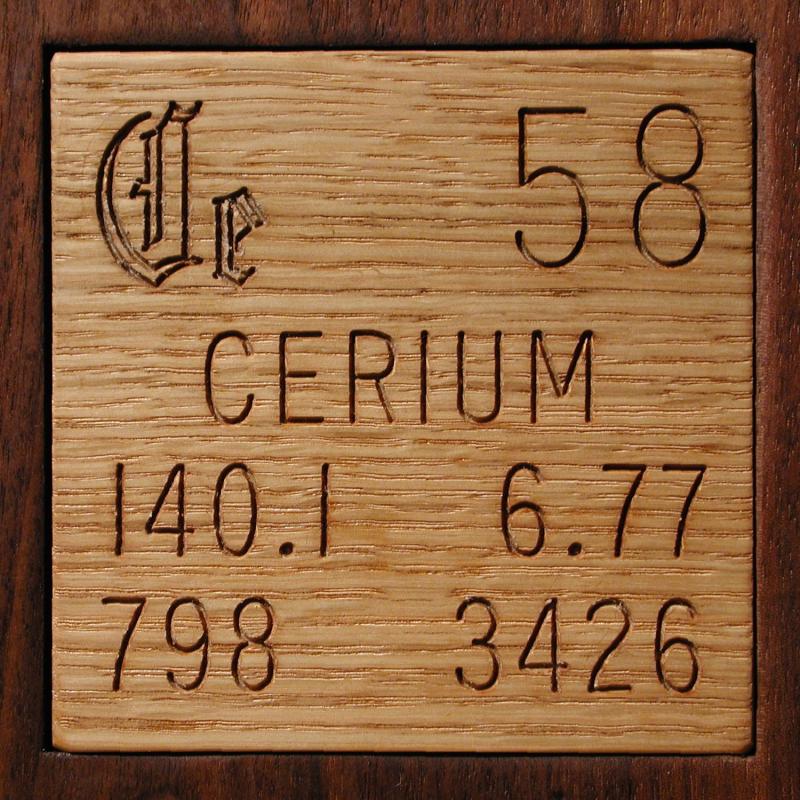
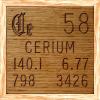
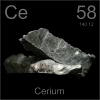
Cerium is one of the most common, cheapest of the "rare earths", which really aren't that rare at all. It is used in lighter flints because it will ignite in air when heated and shaved off in small particles, as when a steel wheel strikes a "flint" (which isn't made of flint at all, but of an alloy consisting of iron, cerium, and several other rare earths).
|
|
| |
|
|
|
|
|
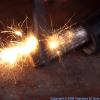
  Mischmetal striking flint. Mischmetal striking flint.
Removed from the camp fire starter that supplied the Magnesium sample, purchased at Walmart in April 2002. Probably about 20-30% Cerium overall, the remainder being other rare earths and iron.
Source: Walmart
Contributor: Theodore Gray
Acquired: 15 April, 2002
Price: $4
Size: 3"
Purity: <30%
|
|
|
|
|
|
|
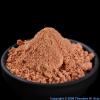
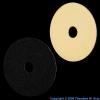
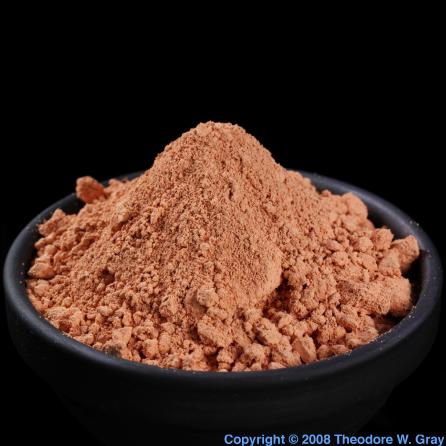
  Optical polishing powder. Optical polishing powder.
Cerium oxide in the form of a very fine powder is used as a polishing compound for optical glass. Supposed it works better than aluminum oxide or other abrasives in certain situations. It's very cheap: A few dollars a pound, which tells you something about how rare the "rare" earths actually are, which is not very.
Source: eBay seller fellows
Contributor: Theodore Gray
Acquired: 1 October, 2002
Price: $5
Size: 1"
Purity: <30%
Sample Group: Powders
|
|
|
|
|
|
|
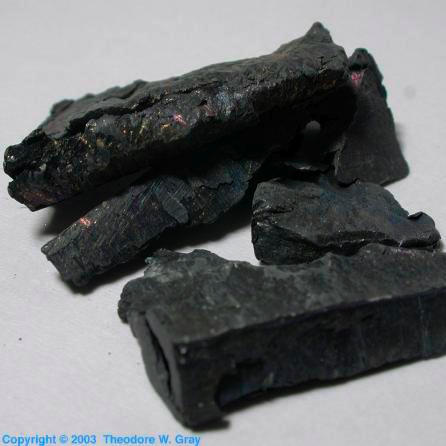
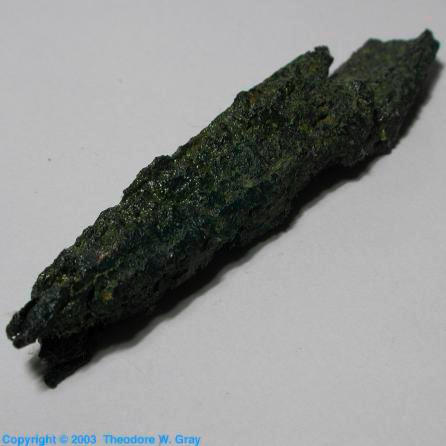
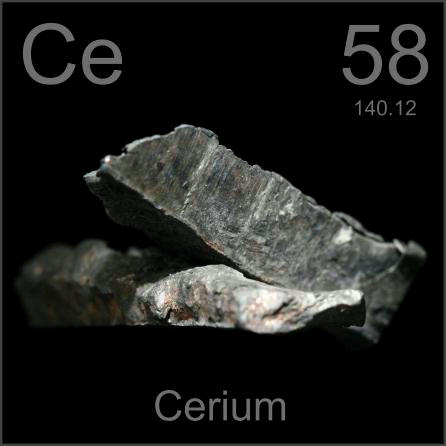
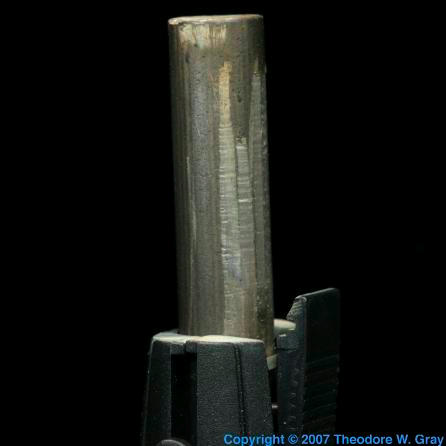
Metal sliver.
This sample of metallic cerium arrived coated in mineral oil in a plastic bag, because it would otherwise likely have oxidized away in transit. I cleaned it up some and put it in a dish covered with fresh mineral oil.
It happened to arrive in my mailbox on the very day Oliver Sacks was visiting the Periodic Table Table, so we got to open it together.
Source: Andrew Goodall
Contributor: Andrew Goodall
Acquired: 12 November, 2002
Price: Donated
Size: 1"
Purity: >80%
|
|
|
|
|
|
|
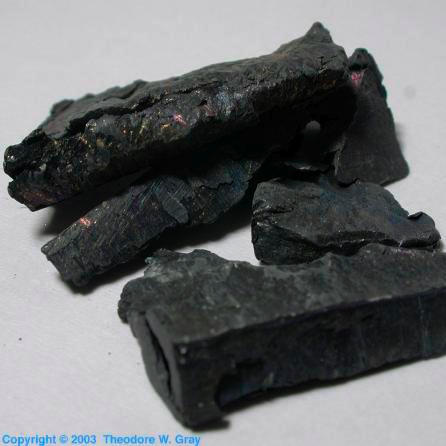
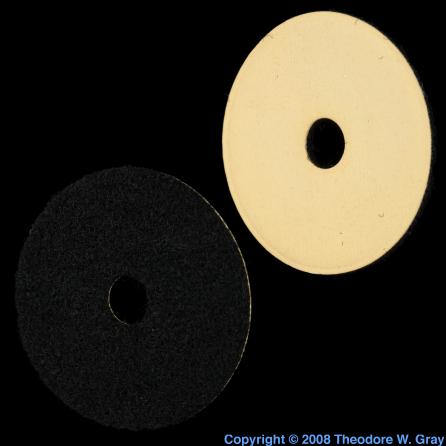
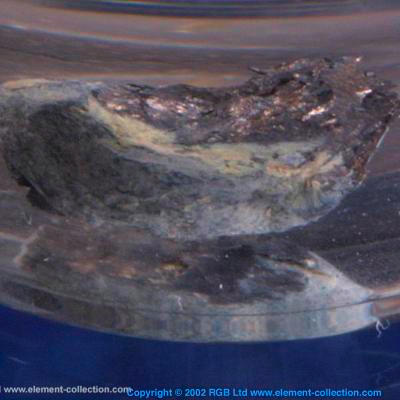
Lump.
This sample arrived with a full set of lanthanides at a time when I was missing europium, terbium, holmium, ytterbium, and of course lutetium.
This very kind donation from Max Whitby of The Red Green & Blue Company in England completed my element collection, to the extent that it gave me a plausible sample of every element one can plausibly have a sample of. (The Red Green & Blue Company is selling a periodic table collection containing similar samples of the same stuff, and if you want a ready-made collection of elements, that's the first place I would look.)
To learn more about the set you can visit my page about element collecting for a general description or the company's website which includes many photographs and pricing details. I have two photographs of each sample from the set: One taken by me and one from the company. You can see photographs of all the samples displayed in a periodic table format: my pictures or their pictures. Or you can see both side-by-side with bigger pictures in numerical order.
The picture on the left was taken by me. Here is the company's version (there is some variation between sets, so the pictures sometimes show different variations of the samples):
Source: Max Whitby of RGB
Contributor: Max Whitby of RGB
Acquired: 20 December, 2002
Text Updated: 11 August, 2007
Price: Donated
Size: 0.5"
Purity: 99.4%
|
|
|
|
|
|
|
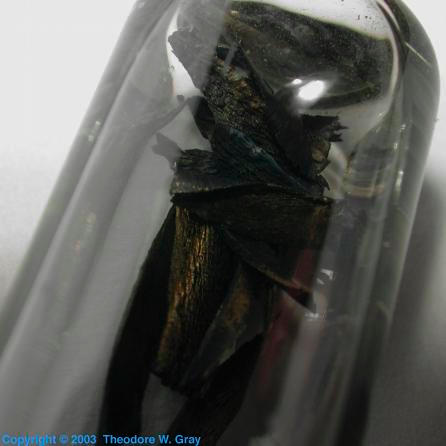
Sample from the Everest Set.
Up until the early 1990's a company in Russia sold a periodic table collection with element samples. At some point their American distributor sold off the remaining stock to a man who is now selling them on eBay. The samples (except gases) weigh about 0.25 grams each, and the whole set comes in a very nice wooden box with a printed periodic table in the lid.
To learn more about the set you can visit my page about element collecting for a general description and information about how to buy one, or you can see photographs of all the samples from the set displayed on my website in a periodic table layout or with bigger pictures in numerical order.
Source: Rob Accurso
Contributor: Rob Accurso
Acquired: 7 February, 2003
Text Updated: 29 January, 2009
Price: Donated
Size: 0.2"
Purity: >99%
|
|
|
|
|
|
|
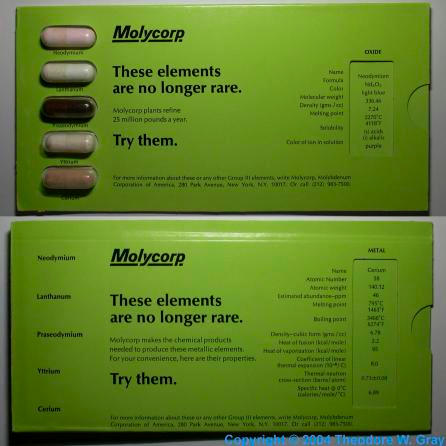
Advertising set.
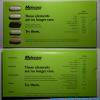
This lovely little set of rare earth oxides was made to promote the fact that rare earths really aren't very rare. Once the technology was developed to separate and purify then economically, they became quite common in fact. There is no date on this piece which is a pity, but I would guess it was made in the 1960's.
Source: SoCal (Nevada), Inc
Contributor: Theodore Gray
Acquired: 23 July, 2004
Price: $20
Size: 8"
Purity: >20%
|
|
|
|
|
|
|
|
|
|
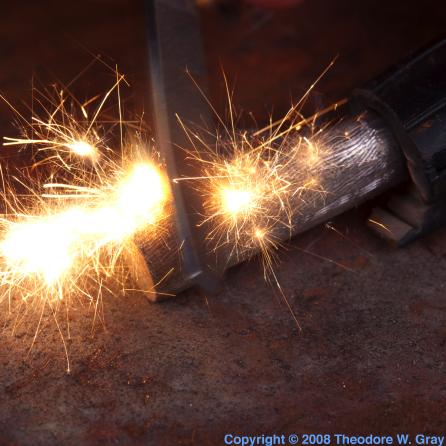
Campfire lighter flint.
This is basically a huge, 1/2" diameter x 2.5" long lighter flint, mounted in a case that has a sharp steel blade positioned so you can scrape it against the flint, creating a shower of sparks. The "Spin" and "Rotate" videos are actually video showing what it looks like when you scrape the flint with a file, generating even more sparks.
Source: eBay
Contributor: Theodore Gray
Acquired: 16 April, 2009
Text Updated: 16 April, 2009
Price: $30
Size: 3"
Purity: <20%
|
|
|
|
|
|
|
|
|
|
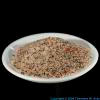
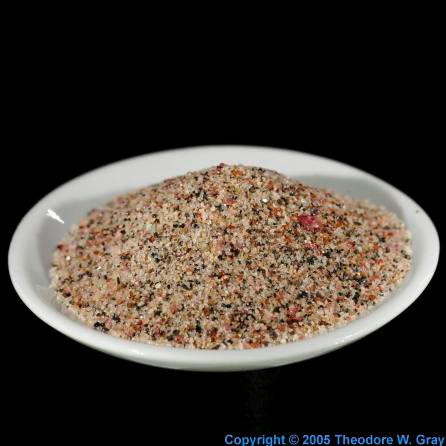
Monazite Sand.
Monazite is a thorium-bearing mineral that occurs in sand deposits in a number of places around the world. Only a small proportion of the sand in this sample is actually monazite: It is probably somewhat selected compared to normally occurring sand deposits, but not much. It's kind of remarkable, really, that you can collect thorium just by scooping it up with a shovel.
Source: Max Whitby of RGB
Contributor: Max Whitby of RGB
Acquired: 20 September, 2005
Price: Donated
Size: 1.5"
Composition: (Ce,La,Nd,Th)PO4
|
|
|
|
|
|
|
|
|
|
|
|
|
|
|
|
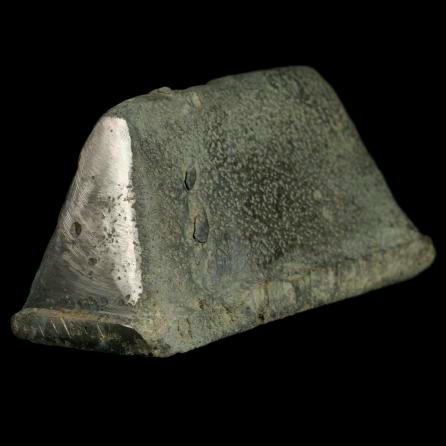
Mischmetal.
Rare earths are notoriously hard to separate from one another. In fact the hardest part about discovering some of them was proving that a substance thought to be a single pure element was in fact a mixture of several extremely similar ones.
Since they are chemically so similar, it's not surprising that they also occur together in nature: Ores that contain one inevitably contain several of the others as well. This, combined with the difficulty of separating them, made them quite rare and unusual in pure form, until the development of modern, efficient separation techniques.
But their very chemical similarity also means that in many cases it's really not necessary to separate them in the first place. If cerium will do, then so will lanthanum, or half a dozen others. A case in point is lighter "flints" which are actually made of a mixture of rare earths, primarily cerium and lanthanum, alloyed with iron. The exact ratio of rare earths in a given lighter flint isn't determined by some formula, it's determined by whatever came out of the mine that day. It would be entirely pointless to separate out and use just one in pure form: It would work, by why bother when the raw mixture works just as well?
This mischmetal has not been alloyed with iron, as it would be in a flint: It's a mixture of predominantly cerium (54% cerium is a common for mischmetal), with most of the remainder being lanthanum. Others in the lanthanide series most likely contribute a few percent of the total.
It's very sparky! Just shaving it with a knife produces sparks, a bit like you get when grinding iron on a grinding wheel, except you don't need the grinding wheel. (You can see that I've scraped the oxide coating off one face, a task for which I used a utility knife and file, producing great quantities of sparks in the process.) It's said that blocks like this are sometimes dragged underneath cars to produce a shower of sparks for special effects in movies or performances.
It's a bit like super-sensitive magnesium. Magnesium shavings will also burn, just not spontaneously like those off this block. Blocks of magnesium are commonly sold as camp fire starters, but this stuff would work way better! In fact, to start the shavings off a magnesium fire starter, you use a flint made with this stuff.
When it burns, it burns much the same way as magnesium. Metal fire is very different in appearance from wood, paper, oil, or other types of fire. One reason is that in most fires what's burning is primarily gas driven off from the solid or liquid material. Thus you get bright tongues of flame flickering above whatever is burning. But in a metal fire there is no vapor given off, so only the solid (or if it gets hot enough, liquid) metal is burning. This makes for a very compact point source of light, rather than a spread-out flame. Normal flames also tend to be yellow almost all the time, due in part to the strong yellow-orange emission line of sodium, which is present in some quantity in nearly all natural materials. Metal fires on the other hand tend to be whiter, magnesium being a particularly good example of a very, very white flame.
Another difference is that the metal oxides that build up from burning metal are extremely resistant to heat (magnesium oxide is a common ingredient in high temperature insulation), and totally non-volatile (unlike the carbon dioxide that results from burning organic matter, which is a gas). Thus as metal is burning, it tends to form a crust of oxide around itself which slowly chokes off the flow of oxygen, causing the remaining metal to burn more and more slowly. (I have a story about burning magnesium which includes photographs of this lovely phenomenon.)
I haven't yet set a whole block of this stuff on fire, but I've ordered a couple more and will update when I have pictures of what happens when you actually get a big chunk of it going. I'm betting that blocks of it burn a lot like blocks of magnesium, just faster. Of course I could be wrong: The added rate of reaction could blow off the oxide fast enough to avoid congestion, resulting in a much more dramatic and complete combustion. We shall see.
Source: United Nuclear
Contributor: Theodore Gray
Acquired: 3 July, 2006
Text Updated: 4 July, 2006
Price: $45
Size: 4"
Composition: CeLa
|
|
|
|
|
|
|
Ferro-cerium fire starter.
This is a great little gadget, a BlastMatch fire starter from www.survivalinc.com. It consists of a hefty (ca. 1/2" diameter) stick of iron-mischmetall alloy (mischmetall is a mixture of various rare earth elements typically containing a majority of cerium, so this alloy is also known as ferro-cerium). Ferro-cerium is what lighter flints are made of, so this is basically a giant lighter flint, which creates sparks when struck or scraped with something hard. This gadget includes a hard steel blade and a spring mechanism that lets you scrap the blade hard against the ferro-cerium stick just by jabbing the stick down on a hard surface. The net effect is that if you hold it firmly and push it hard down onto a surface, you get a shower of sparks flying off it, enough to light any sort of dry tinder, paper, etc. It's meant to be used as a camp fire starter or survival tool, but if you enjoy showers of sparks, this is way too much fun to leave to wet mornings in the woods.
Source: Survival, Inc
Contributor: Theodore Gray
Acquired: 24 February, 2007
Text Updated: 24 February, 2007
Price: $25
Size: 2"
Composition: FeCe
|
|
|
|
|
|
|
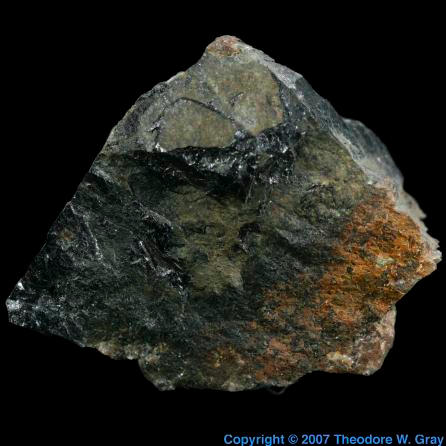
Confiscated Davidite.
This mildly radioactive Davidite ore was confiscated from a student who brought it to school, not realizing that schools tend to freak out about radioactive things, whether they are truly dangerous or not. The original source is United Nuclear and it's perfectly legal.
Source: Anonymous
Contributor: Anonymous
Acquired: 8 May, 2007
Text Updated: 9 May, 2007
Price: Donated
Size: 1"
Composition: (La,Ce,Ca)(Y,U)(Ti,Fe)20O38
|
|
|
|
|
|
|
More confiscated Davidite.
This mildly radioactive Davidite ore was confiscated from a student who brought it to school, not realizing that schools tend to freak out about radioactive things, whether they are truly dangerous or not. The original source is United Nuclear and it's perfectly legal.
Source: Anonymous
Contributor: Anonymous
Acquired: 8 May, 2007
Text Updated: 9 May, 2007
Price: Donated
Size: 1"
Composition: (La,Ce,Ca)(Y,U)(Ti,Fe)20O38
|
|
|
|
|
|
|
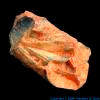
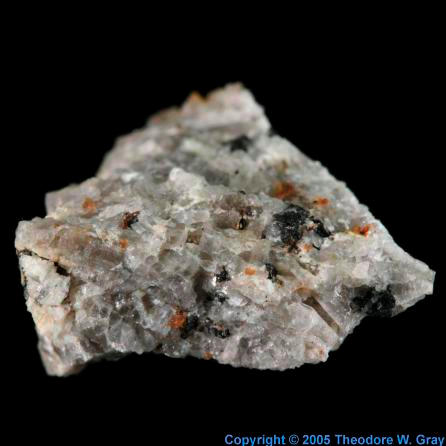
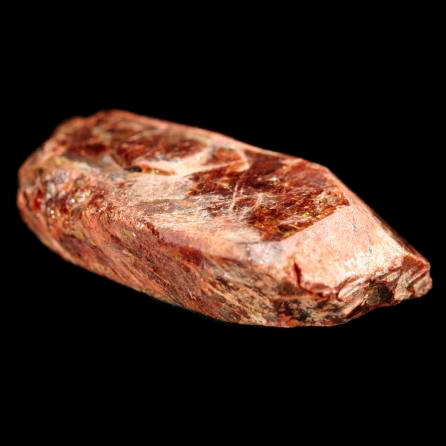
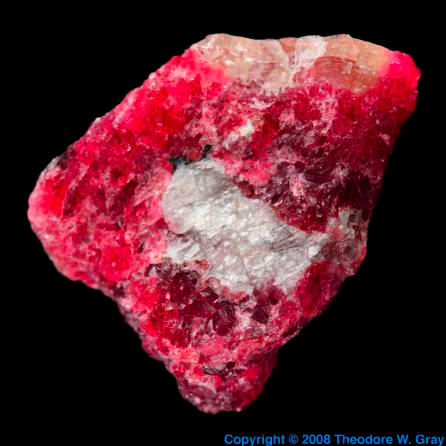
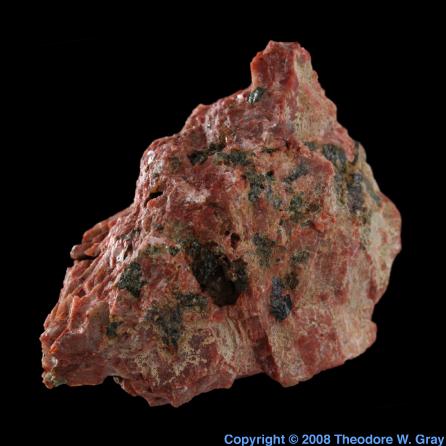
Eudyalite.
Description from the source:
Eudyalite (Na4(CaCe)2(Fe+2Mn+2Y+ZrSi8O22(OHCl)2 trig.), Kipawa Alcalyne Complex, Villedieu Tow., Quebec, Canada. Red, granular, with white fibrous Agrellite and beige Vlasovite. A rich thumbnail. 2,2x1,7x1 cm; 5 g.
Source: Simone Citon
Contributor: John Gray
Acquired: 26 September, 2008
Text Updated: 28 September, 2008
Price: Trade
Size: 0.85"
Composition: Na4(CaCe)2(Fe,2Mn,2Y).ZrSi8O22(OHCl)2
|
|
|
|
|
|
|
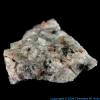
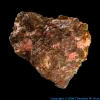
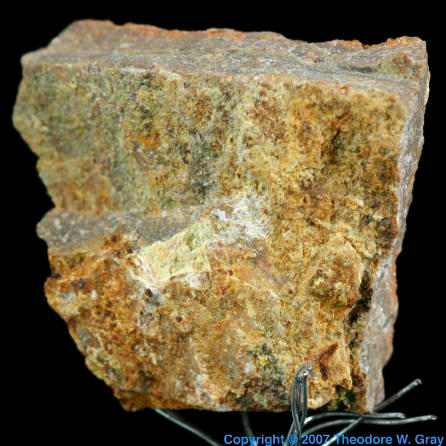
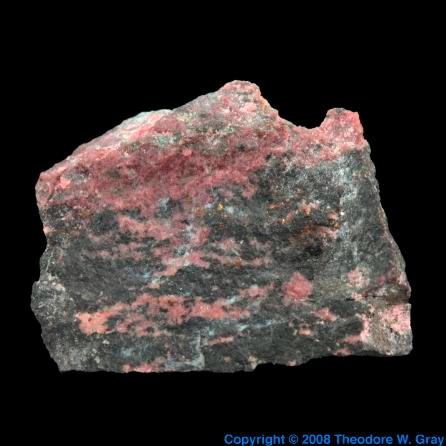
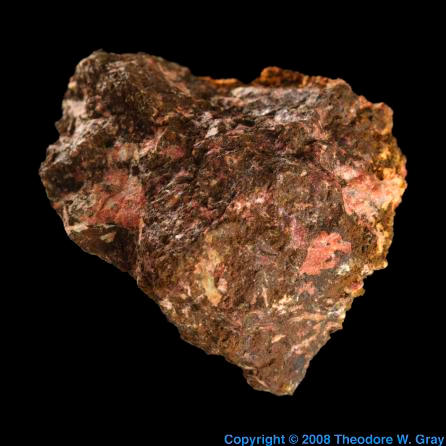
Cerite.
Description from the source:
Cerite ( (Ce Ca)10 (Si O4)6 (OH F)5 trig.), Mine of Bastnaes near Riddarhytta, Westmanland, Sweden. Pinkish masses on matrix. Rare. 2x1,7x0,8 cm; 8 g with box.
Source: Simone Citon
Contributor: John Gray
Acquired: 30 September, 2008
Text Updated: 1 October, 2008
Price: Trade
Size: 0.75"
Composition: (CeCa)10(SiO4)6(OH.F)5
|
|
|
|
|
|
|
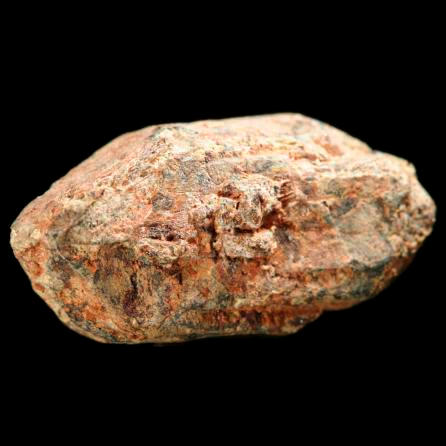
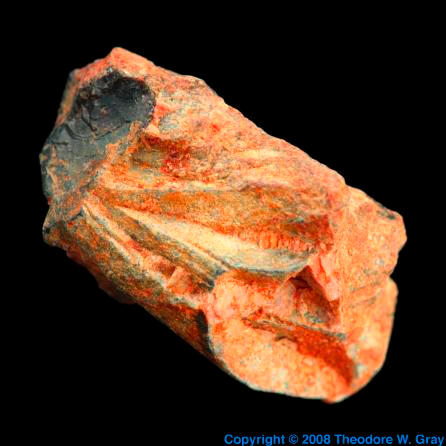
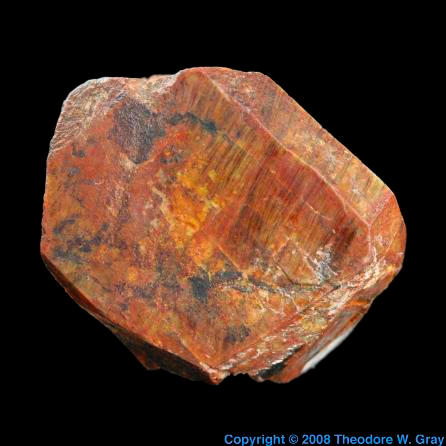
Euxenite.
Description from the source:
Euxenite ( (Y Ca Ce U Th) (Nb Ta Ti)2 O6 orth.), Trout Creek Pass, Chafee Co. Colorado, USA. Crystal cluster, nice and rare example. 2x1,5x1 cm; 14 g with box.
Source: Simone Citon
Contributor: John Gray
Acquired: 30 September, 2008
Text Updated: 1 October, 2008
Price: Trade
Size: 0.75"
Composition: (YCaCeUTh)(NbTaTi)2O6
|
|
|
|
|
|
|
|
|
|
|
|
|
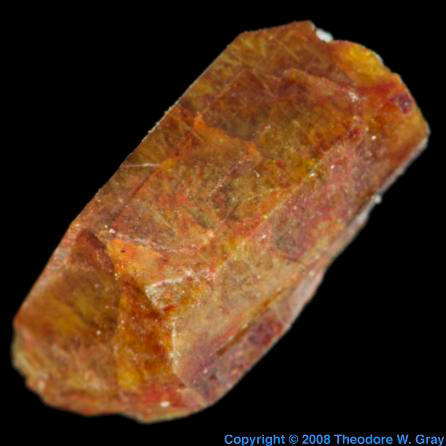
Euxenite from Jensan Set.
This sample represents lutetium in the "The Grand Tour of the Periodic Table" mineral collection from Jensan Scientifics. Visit my page about element collecting for a general description, or see photographs of all the samples from the set in a periodic table layout or with bigger pictures in numerical order.
Source: Jensan Scientifics
Contributor: Theodore Gray
Acquired: 10 January, 2009
Text Updated: 10 January, 2009
Price: Anonymous
Size: 0.6"
Composition: (Y,Ca,Ce,Lu,U,Th)(Nb,Ta,Ti)2O6
|
|
|
|
|
|
|
Monazite.
Description from the source:
Monazite ( (Ce La Nd Th) P O4 mon.), Steli near Tveit, Iveland, Nordge. Extremely well crystallized example. 0,8x0,4x0,4 cm; 5 g with box.
Source: Simone Citon
Contributor: John Gray
Acquired: 28 January, 2009
Text Updated: 29 January, 2009
Price: Trade
Size: 0.3"
Composition: (CeLaNdTh)PO4
|
|
|
|
|
|
|
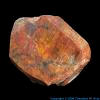
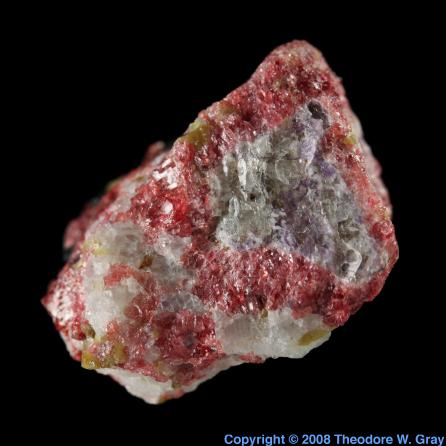
Miserite.
Description from the source:
Miserite (K (Ca Ce)6 Si8 O22 (OH F)2 tric.), Kipawa Alcalyne Complex, Villedieu Tow., Quebec, Canada. Purple section crystals with granular red Eudyalite and beige Vlasovite. Rich in rare earth elements. 2x1,5x1,5 cm; 6 g.
Source: Simone Citon
Contributor: John Gray
Acquired: 11 March, 2009
Text Updated: 3 April, 2009
Price: Trade
Size: 0.75"
Composition: K(Ca,Ce)6Si8O22(OH,F)2
|
|
|
|
|
|
|
|
|
|
|
|
|
|
|
|
|
|