|
|
|
|
|
|
|
|
|
|
|
|
|
|
|
|
Helium is the second most common element in the universe, representing about 10% of the total matter. (The other 90% is hydrogen, all other elements represent an insignificantly small fraction of the total.) While helium is very common in the universe, most of it is in the stars: on earth it is actually quite rare. It is created deep in the earth from the radioactive decay of uranium and thorium (which also gives the earth its internal heat), and is "mined" from natural gas and oil wells (it comes up with the natural gas and is separated and stored). It's also constantly seeping up from the ground all around us, but it is so light that almost all of it escapes into space fairly rapidly: There is very little in the atmosphere at any given time.
Helium is a noble gas, which means it doesn't react with anything for all practical intents and purposes. It's used as an inert shield gas to protect things from oxidation. (For example, "heli-arc" welding, which uses a stream of inert gas to prevent oxidation of metal as it is being welded, is named after helium even though most heli-arc welding is done with argon because it's cheaper.)
|
|
| |
|
|
|
|
|
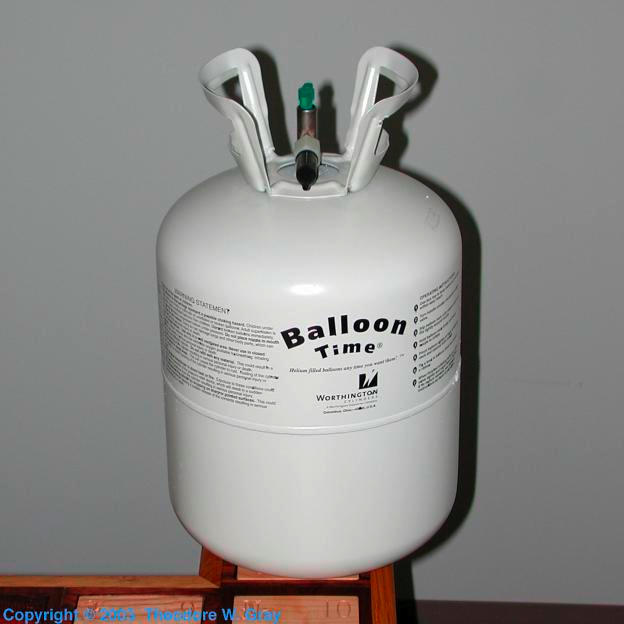
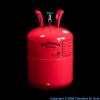
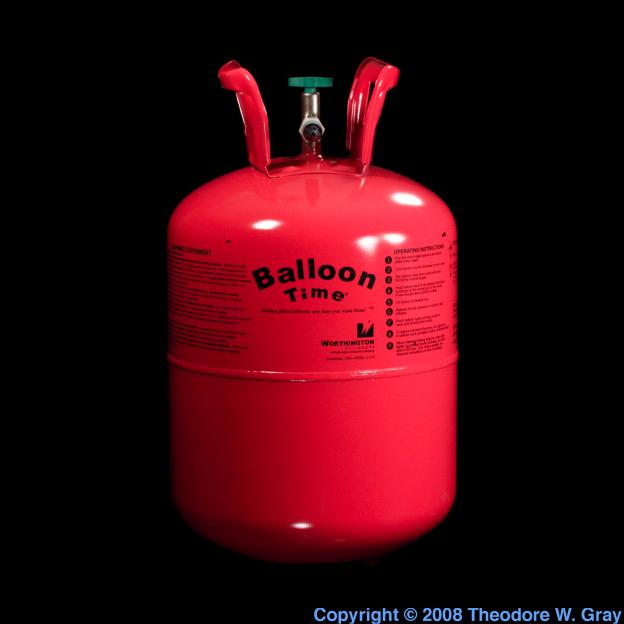
  Disposable party balloon tank. Disposable party balloon tank.
You can buy these lightweight tanks of helium at Walmart or any party supply store. They are thin-walled steel, not like the heavy gas cylinders used in welding, and only contain enough helium for about 30 balloons. On the plus side, they come with a supply of balloons and ribbon, so you're all set to entertain the kids with elements (at 75 cents a pop, so to speak).
Source: Walmart
Contributor: Theodore Gray
Acquired: 7 August, 2002
Price: $20
Size: 18"
Purity: >90%
|
|
|
|
|
|
|
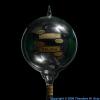
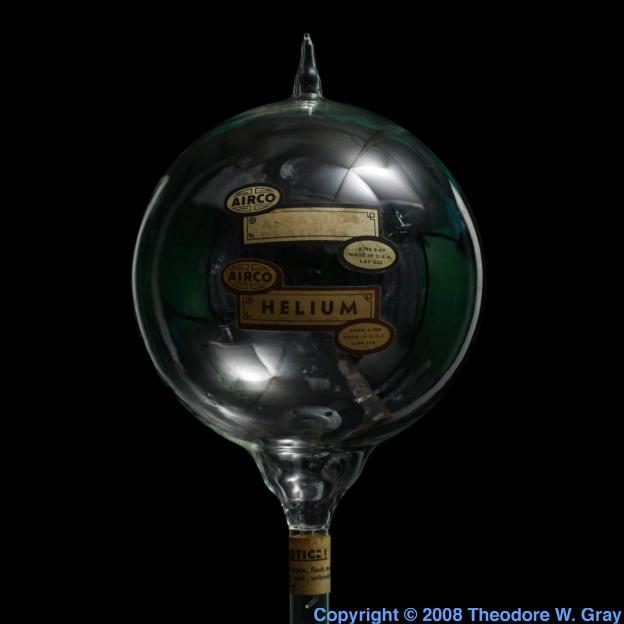
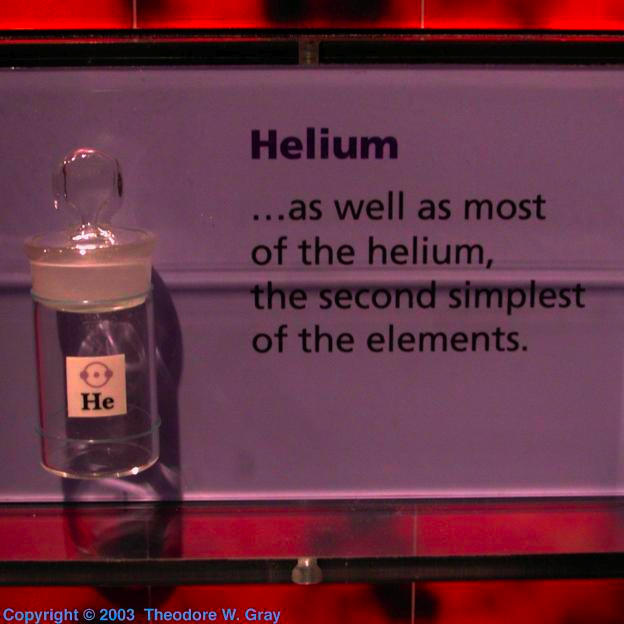
Antique reagent flask.
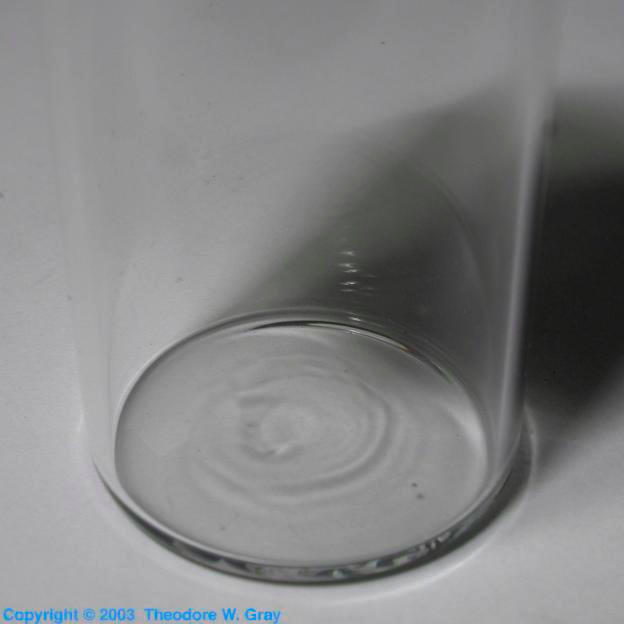
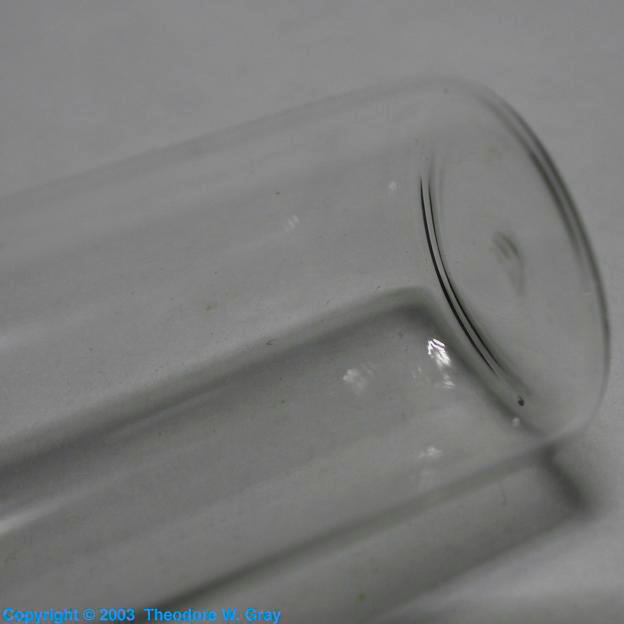
I got a set of five different noble gas flasks on eBay for $13.50, which seemed like a good deal even though the seller described them as "probably empty". I very much doubt, however, that they are empty: At the bottom where the flask meets the tube, there is a tiny inner breakaway seal that is completely intact on all five of them. There's no visible way for the gas to have escaped. I've learned that one normally uses a steel ball, held up with a magnet, to break the seal: When you've hooked up and flushed out all the connecting tubes, you pull away the magnet and the ball drops onto the seal, breaking it and releasing the gas.
After many unworkable suggestions for proving whether the gases were still in there, several people came up with the idea of using a high voltage transformer, such as one finds in those now inexpensive plasma ball novelty lights, to try to set up an arc inside the flask, and identify the gas from the color of the discharge. Whether this is possible is sensitive to the pressure of the gas, which is not known.
Fortunately, it worked beautifully on three out of the five, and proved beyond a reasonable doubt that those three at least contain the gas claimed. The others almost certainly failed because the type and pressure of gas in them does not support an arc, not because they are empty. In fact, if they were empty, I would have gotten an arc, because the arc works through up to about half an inch of ordinary air.
You can see pictures of all the arcs along with a picture of the display stand I built for them (between 10PM and midnight of the evening they arrived) a using some of the same Carlson Maple used for the noble gas tiles on the table.
By the way, isn't it a cute oxymoron: Reagent-grade non-reactive gas.
Source: eBay seller tictoxx
Contributor: Theodore Gray
Acquired: 28 August, 2002
Text Updated: 20 November, 2008
Price: $3
Size: 9"
Purity: 99.95%
|
|
|
|
|
|
|
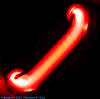
Mounted arc tube.
In some ways, gases are a pain from a sample point of view. With the exception of chlorine and bromine they all look exactly the same: Like nothing at all. My beautiful set of noble gas flasks is beautiful because of the flasks, not what's in them, which is indistinguishable from plain air or vacuum. (So much so that I got them for a bargain price because the seller thought the were empty.)
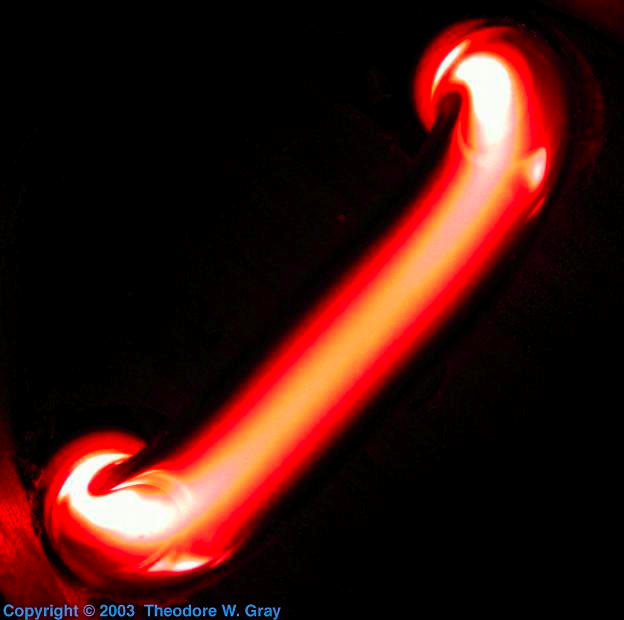
But set up an electric current through almost any gas, and things are completely different. The current ionizes the gas, and when the electrons fall back into their orbits, they emit light of very specific frequencies. These spectral lines can easily be seen with even a very cheap pocket spectroscope, and they give the glowing tubes very unusual colors. So unusual in fact that they are basically impossible to photograph. The pictures here simply don't look at all like the real colors of these tubes, which cannot be represented by the limited red, green, and blue mixtures available in computer or printed photographs.
David Franco helped arrange these tubes, which were made by a guy who specializes in noble gas tubes and Geissler tubes (click the source link). I have tubes installed in each of the five stable noble gas spots in the table, hooked up underneath to a high voltage transformer. They are really quite beautiful. On my Noble Rack page I have all the pictures collected, along with pictures of arcs I made in my other collection of noble gas flasks.
Source: Special Effects Neon
Contributor: Theodore Gray
Acquired: 22 November, 2002
Price: $35
Size: 2.5"
Purity: >90%
|
|
|
|
|
|
|
Sample from the RGB Set.
The Red Green and Blue company in England sells a very nice element collection in several versions. Max Whitby, the director of the company, very kindly donated a complete set to the periodic table table.
To learn more about the set you can visit my page about element collecting for a general description or the company's website which includes many photographs and pricing details. I have two photographs of each sample from the set: One taken by me and one from the company. You can see photographs of all the samples displayed in a periodic table format: my pictures or their pictures. Or you can see both side-by-side with bigger pictures in numerical order.
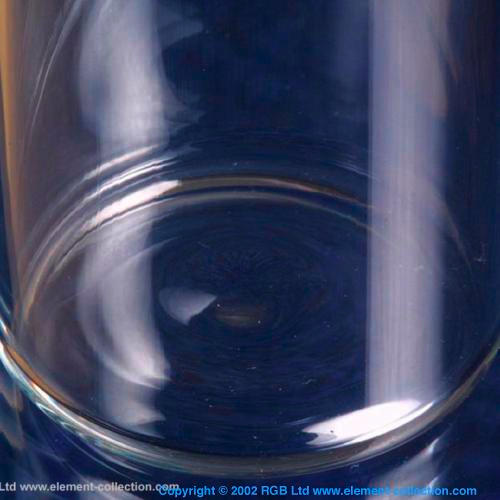
The picture on the left was taken by me. Here is the company's version (there is some variation between sets, so the pictures sometimes show different variations of the samples):
Source: Max Whitby of RGB
Contributor: Max Whitby of RGB
Acquired: 25 January, 2003
Text Updated: 11 August, 2007
Price: Donated
Size: 0.2"
Purity: 99.9%
|
|
|
|
|
|
|
Sample from the Everest Set.
Up until the early 1990's a company in Russia sold a periodic table collection with element samples. At some point their American distributor sold off the remaining stock to a man who is now selling them on eBay. The samples (except gases) weigh about 0.25 grams each, and the whole set comes in a very nice wooden box with a printed periodic table in the lid.
To learn more about the set you can visit my page about element collecting for a general description and information about how to buy one, or you can see photographs of all the samples from the set displayed on my website in a periodic table layout or with bigger pictures in numerical order.
Source: Rob Accurso
Contributor: Rob Accurso
Acquired: 7 February, 2003
Text Updated: 20 November, 2008
Price: Donated
Size: 0.2"
Purity: >99%
|
|
|
|
|
|
|
Museum-grade sample.
In early 2004 Max Whitby and I started selling individual element samples identical or similar to the samples we use in the museum displays we build. These are top-quality samples presented in attractive forms appropriate to the particular element. They are for sale from Max's website and also on eBay where you will find an ever-changing selection of samples (click the link to see the current listings).
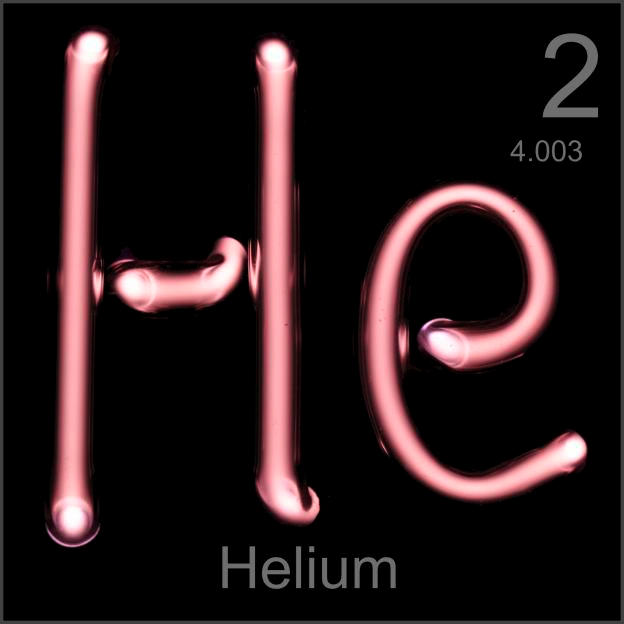
This is a lovely hand-made discharge tube, powered by a small high-voltage transformer. The color is characteristic of the noble gas contained in the tube, and of course the shape spells the element's atomic symbol. In our large periodic table displays we use larger versions of these tubes: The ones photographed here are about 3" tall, but the other ones look basically identical, just bigger.
I chose this sample to represent its element in my Photographic Periodic Table Poster. The sample photograph includes text exactly as it appears in the poster, which you are encouraged to buy a copy of.
Source: Theodore Gray
Contributor: Theodore Gray
Acquired: 18 April, 2005
Text Updated: 11 August, 2007
Price: See Listing
Size: 4"
Purity: >99%
Sample Group: RGB Samples
|
|
|
|
|
|
|
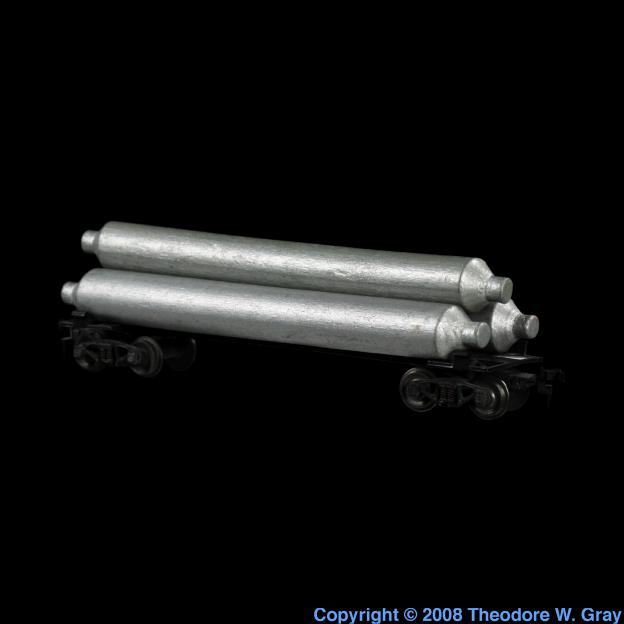
Model train car.
This is a fairly crude wooden model of what a helium transport train car looks like. Its main advantage over a real helium transport train car is that it fits in my studio.
Source: eBay seller tgalloway123
Contributor: Theodore Gray
Acquired: 7 July, 2006
Text Updated: 8 February, 2009
Price: $17
Size: 4"
Purity: 0%
|
|
|
|
|
|
|
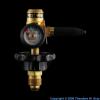
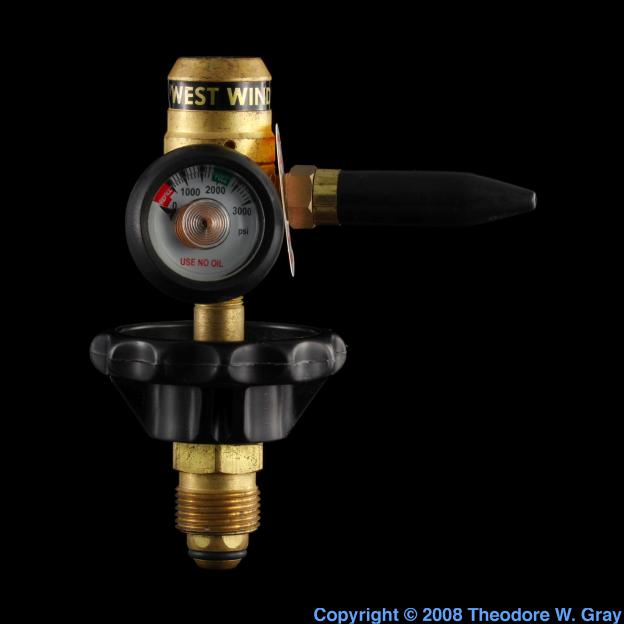
Balloon filling regulator.
This is a common type of regulator used to fill helium balloons from a high-pressure tank. The gauge reads the pressure of the tank itself (notice the scale goes up to 3000psi, a very high pressure). The regulator reduces the pressure to maybe about 50psi (this is not adjustable). To release helium you slip the balloon over the rubber nozzle and push it to one side or another. This type of regulator works only with latex balloons, not the metalized Mylar type. Those must be filled with a special ultra-low pressure regulator because they have no stretch: They go from being full to bursting over an extremely small range of gas volume, so they must be filled to a measured pressure, not to a certain volume.
Source: eBay seller npappas0013
Contributor: Theodore Gray
Acquired: 28 February, 2009
Text Updated: 1 March, 2009
Price: $20
Size: 6"
Purity: 0%
|
|
|
|
|
|
|
|
|
|
|
|
|
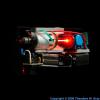
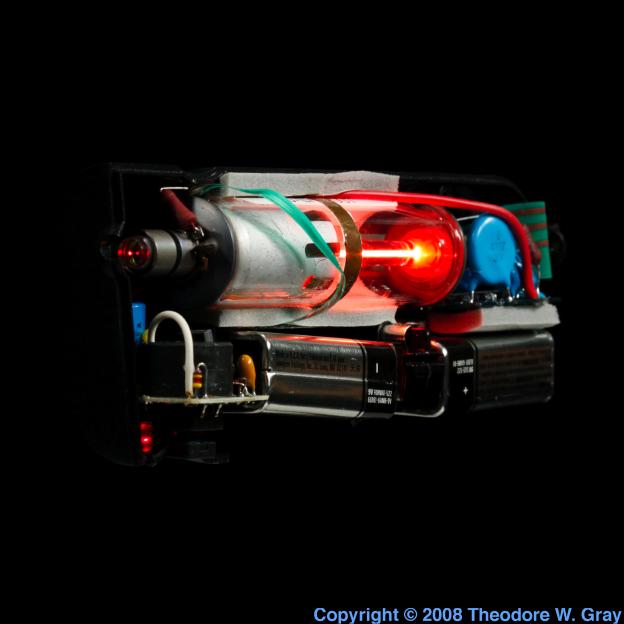
Nelium-neon laser pointer.
Sure, you've seen laser pointers before, what are they, maybe $3 at the corner gas station? But those are laser diode pointers, tiny solid state devices that run on a watch battery. This is something far more exotic, a relic of a time before the very existence of laser diodes. Gather 'round children and I will tell you a tale of those times.
Back in the stone age, I'm talking here about maybe 1990, lasers were big things made of glass tubes or ruby rods, fed by high voltage power supplies. There were definitively not things you held in your hand. Then one day I see this astounding device in a catalog for the bargain price of only about $300. Having no children or other responsibilities, it seemed like a reasonable thing to buy at the time, and I am now very glad that I did, because I cannot find any evidence of this product ever having existed, not even on eBay. But I have one, and it still works.
It is a hand-held helium neon gas discharge laser that runs on two 9V batteries, for about 15 minutes. What you're looking at is the laser tube in operation with the side cover taken off. Notice the bit of foam stuck between the battery and the circuit board with a round blue capacitor on it? I stuck that in there because otherwise the miniature high voltage power supply arcs over to the battery case.
You really need to watch the spin video of this sample (click the Spin link on the left) to see the tube from all directions: We shot the rotation with the device turned on, and when the laser beam points directly at the camera, it hits the CCD and creates a lovely diffraction pattern as it reflects back from the inside surfaces of the lens. (No, it didn't damage the CCD.)
One very interesting thing to note: The color of the glow you see inside the tube is different from the color of the light coming out of the laser end. The light coming out the end is the neon red emission line, while the color coming out the side of the tube is the helium lavender/pink glow. Think about it: This is a completely uniform, isotropic gas, yet it's glowing in two different colors depending on what direction you look at it from. How can this be? That is the magic of the laser: The cavity mirrors organize the light from the neon line and stimulate (the S in LASER) it to be emitted only in line with the beam. The helium emission occurs in all directions randomly.
I thought I had lost thing thin, and when it turned up in my office I was overjoyed, it is one of my favorite gadgets, quite a marvel of miniaturization even if it is a hundred times bigger and a hundred times more expensive than the current model.
Source: Theodore Gray
Contributor: Theodore Gray
Acquired: 28 February, 2009
Text Updated: 1 March, 2009
Price: $300
Size: 6"
Composition: HeNe
|
|
|
|
|
|
|
The Universe. (External Sample)
The universe is only about 10% helium, but that's better than some of our other samples, and it's getting more pure with every passing billion years. As an external sample, this one is not physically located within the table, but rather in its complement. (This is the famous Hubble Deep Field image.)
Location: The Universe
Photographed: 3 October, 2002
Size: 6000000000000000000000000000"
Purity: 10%
|
|
|
|
|
|
|
|
|
|
|
|
|
|
|